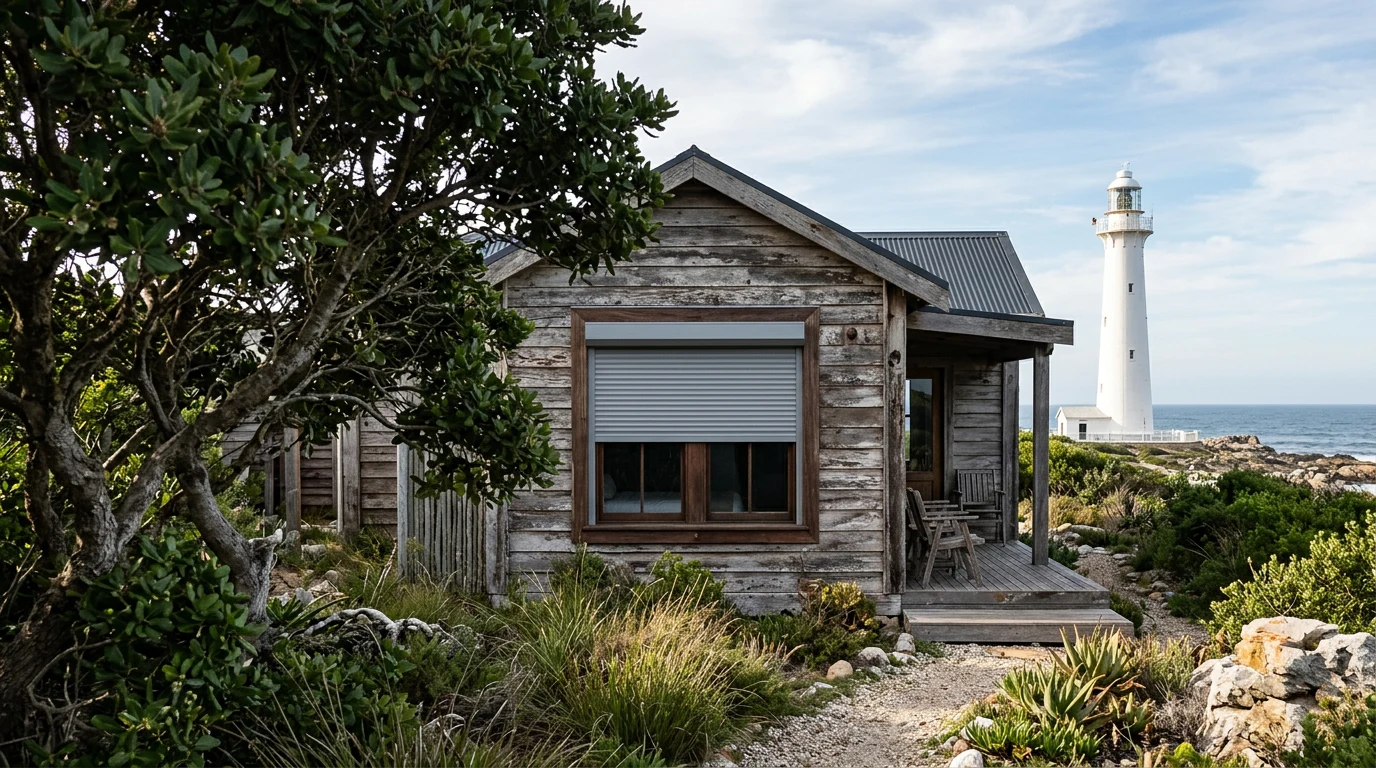
The windiest inhabited point we serve
Kommetjie sits low and flat against a wide dune belt at the far south-western tip of the Cape Peninsula, inside the Table Mountain National Park’s Cape Point section boundary — a genuinely different physical setting to Simon’s Town’s mountain-boxed harbour street. The summer south-easter funnels hard around the point, and winter brings strong north-westerly fronts off the Atlantic. Locals plan outdoor living around wind more than they plan around sun, and so do we when we spec a Kommetjie job.
Two kinds of glazing, one wind problem
The building stock splits two ways: older Cape vernacular cottages with smaller punched windows, and a growing number of architect-built beach houses with large glazed walls and stacking doors chasing the dune and ocean view. That second type usually faces west or south-west, so late-afternoon glare and heat gain off open water is real — generally less extreme than the Atlantic seaboard’s dead-on west sun, since more Kommetjie glazing looks across the beach than straight into the sunset, but real enough to specify for.
What we fit here specifically
Roller shutters do genuine work on this coast — shading, not security, and we say that plainly here too — rolling down over the hardest west-facing glazing on demand. External venetians suit the bigger architect-built glass walls where heat needs stopping at the facade. Folding-arm awnings and zip screens both need a wind sensor as the responsible spec, not an optional extra, given how hard this point gets hit; a zip screen’s taut side channels generally cope with more wind than an open awning does. Because low, flat, dune-fronted homes get salt-laden air at ground level across the whole village, not just on a sea-facing wall, aluminium venetians beat untreated fabric on every damp, less-ventilated room, not only the ones facing the water.
It’s the same wind-first brief that shapes our spec across the wetland system in Noordhoek, where the exposure is Atlantic rather than dune-level, but no less real.
Conservation, honestly stated
The village borders Table Mountain National Park directly, and the dune belt around it is protected coastal land under the City’s coastal management by-laws. Exterior alterations near the dune boundary can draw more scrutiny than an equivalent inland suburb — worth a plain mention rather than a fixed claim about what any one property may or may not do, and something we’ll flag honestly at the measure.